First Local Answer and First Playable Render on a 16 GB MacBook Air
The first local model milestone was deliberately small. After a night of provider failures, Will asked the local Qwen model to return exactly three words: LOCAL TIER OK.
Getting there required fixing the local runtime first. The June capture reports trouble connecting to a running Ollama instance and a missing server component in the recovered discussion. Reinstalling and launching the application was followed by a successful local run. Qwen3:8b was installed at a reported download size of about 5.2 GB. The transcript contains the requested three words. A LOCAL-TIER note recorded the model and the test, and commit fea77fa preserved the documentation.
That tiny test did something valuable: it isolated local inference from the rest of the platform. It needed no chat connector, no spreadsheet, no media queue, and no autonomous task. It answered one question: could this Mac produce a local response from an installed model? Later that day, the model went into Discord as a private, local only route, with fallbacks removed on purpose so a local experiment could never silently become cloud usage.
What local cost the laptop
The measurements explain why the question needed to stay separate from any performance claim. On the 16 GB MacBook Air, Ollama was reported using roughly 5.6 to 5.9 GB with full GPU residency, and the active context was 4,096 tokens, whatever the larger figure on the model card said. System memory reached approximately 14.75 GB of 16 GB, with memory pressure in the yellow. Local inference was real, and it was competing with everything else the laptop was doing.
A file we could actually play
The same day produced a different kind of proof. An FFmpeg command combined an existing source clip with a separate voiceover, scaled and cropped the picture to 1080 by 1920, and encoded H.264 video with AAC audio. The output was a rough vertical video, not a generated video benchmark and not a finished production. It was a file on disk that Will could open.
The first captured run produced 864 frames: 35.95 seconds of output encoded in 13.22 seconds of wall time, 2.72 times real time, in a 21,949 KiB file. Two later captured executions of the same basic pipeline reported 11.44 and 15.76 seconds. They were separate runs, not a controlled benchmark, and this journal does not average them into a platform claim.
What mattered was repeatability. Commit d64ffa1 added the first rough render, ca49447 added a reusable render command, and 91f75ee added a generic render tool that accepted explicit inputs. The render was also logged in the database with its source paths and a rough render status, so the file could be traced back to its inputs without being mistaken for an approved deliverable.
June 10, by the numbers
- Local model: Qwen3:8b, about 5.2 GB download, 5.6 to 5.9 GB resident while running.
- The test: return exactly three words. Result: LOCAL TIER OK. Documented in commit fea77fa.
- Mac memory during local inference: about 14.75 of 16 GB used, pressure yellow.
- First render: 1080 by 1920, H.264 and AAC, 864 frames, 35.95 seconds of video.
- Encode time: 13.22 seconds for the first captured run, 2.72 times real time, 21,949 KiB output.
Posted at the time
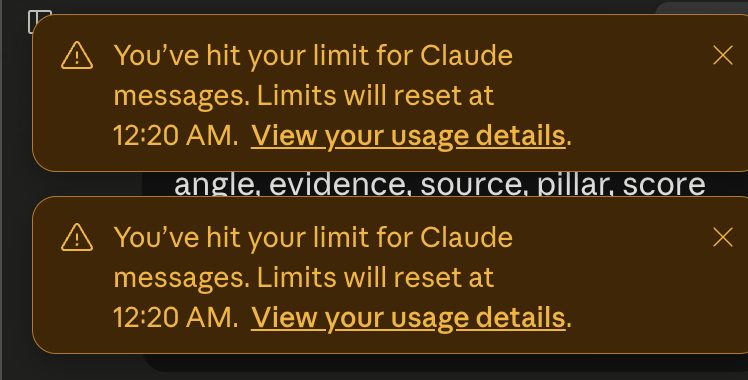
I hit my limits thank you Fable 5
Written later, from the June 9 and 10, 2026 terminal captures and commit records in Will's engineering journal. Timings are the captured runs, not controlled benchmarks.
Ness 🐉